
Is the mirror or camera more accurate? What others see on calls
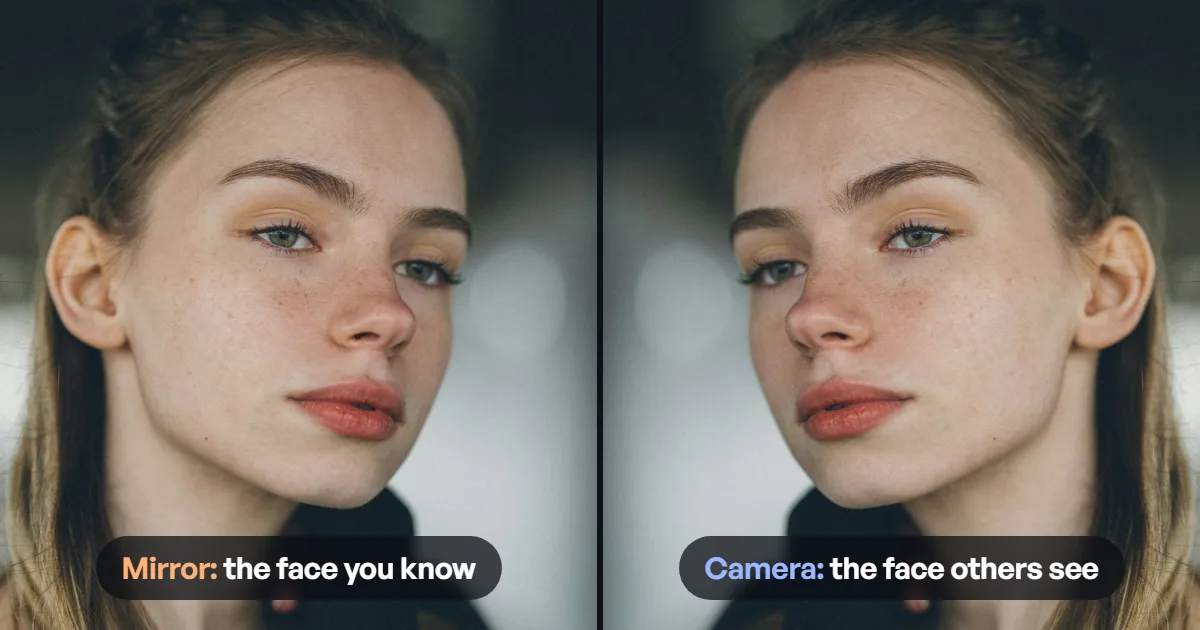
I noticed it in a Google Meet call. Someone shared their screen, and I caught my own video the way the others saw it. It wasn’t the face from my camera preview. My first thought was: have they been seeing me like this the whole time?
I’m a developer, and I don’t go looking for workarounds; I build the tool I need. So I made a small browser extension that lets me choose what others see, and I tested it on two devices before I trusted it in a real call. It turned out I wasn’t building it only for me.
I use Mirrored, because that’s the face I see in the mirror. But which face is actually accurate? Here is what the research says.
Is the mirror or the camera more accurate?
Neither is perfect, and they get it wrong in different ways.
- The mirror flips you. Your left and right swap places. A side parting moves to the other side, a lopsided smile leans the other way, a freckle jumps to the other cheek. You have seen this flipped face every day of your life; the people around you see the other one.
- The camera shows you the right way around, the way people see you across a table. But a phone or laptop camera is usually very close, and that changes the shape of your face (more on that below).
So for “how do others see me”, the camera wins, as long as it is not too close. The most honest picture of you is a photo someone else takes with the back camera from a few feet away.
How do others see me? See both faces now
Turn on your camera below. True shows you the way others see you, Mirror shows the face you know, and Both puts them side by side. Your picture stays on your device: nothing is uploaded or recorded.
Your camera picture stays on this device. No picture is uploaded or recorded.
If the true face looks a little wrong to you, that is normal. Here is why.
Why do I look different on camera than in the mirror?
1. The mirror is flipped, the camera is not
Faces are not perfectly symmetrical. When the left and right sides swap, every small difference swaps too, and your brain notices that “something is off” before you can say what.
2. Why does my nose look bigger on camera?
Because the camera is too close. A phone selfie is often taken about 12 inches (30 cm) from the face, much closer than people stand when they talk to you. At that distance the parts of your face nearest the lens look bigger. Researchers at Rutgers and Stanford estimated that a selfie taken about 12 inches (30 cm) from the face makes the nose look around 30% wider than a picture taken from far away. At 5 feet, a normal portrait distance, the difference practically disappears (Ward et al., 2018).
3. The light is different
At a mirror you usually stand in good light and move until you look right. A webcam often gets light from the screen or from a window behind you, and a laptop on a desk looks up at your chin from below.
4. A photo freezes one moment
In the mirror you see yourself moving and adjust without thinking. A photo freezes a single moment, often one you would never choose to look at.
5. Your brain is on the mirror’s side
You like the face you see most often, and that is the mirror face. This is the part that surprises most people, and it is where your friends come in.
Why do I look better in the mirror than in pictures?
In 1977, psychologists Theodore Mita, Marshall Dermer and Jeffrey Knight showed people two prints of their own face: one as the camera took it, one flipped like a mirror. Most people preferred the mirrored print of themselves. Their close friends preferred the true print (Mita, Dermer and Knight, 1977).
Both groups simply liked the face they had seen more often. Psychologists call this the mere-exposure effect. You see yourself in the mirror every day, so the flipped face feels like you. Your friends see you the other way, so to them the camera face is you.
There is one more twist. In a 2008 study, Nicholas Epley and Erin Whitchurch showed people their own photo next to versions made more and less attractive. People tended to pick an attractively enhanced version as their real face, and did not do the same for strangers (Epley and Whitchurch, 2008). In other words, the face in your head is a little kinder than any picture. That is why a plain photo can feel like a letdown. So if you feel you look ugly in pictures, the picture is usually not the problem: it shows the unflipped face you rarely see, often from too close.
Is the front camera how others see you?
The saved photo usually is; the preview is not. Phones show the front camera preview flipped, like a mirror, so that moving feels natural. On an iPhone, the saved selfie is turned back to the true picture unless you switch on Mirror Front Camera in Settings > Camera. Apple describes it as capturing “the shot as you see it in the front-facing camera frame, rather than reversing it” (Apple). Other phones differ by maker, so take one selfie and compare the preview with the saved photo.
This is why a selfie can look fine on the screen and strange a second later in your gallery: you just went from the mirror face to the camera face.
Do people see you mirrored on video calls?
No. You see one face and everyone else sees the other. Video calls do exactly what the phone preview does. In Google Meet, Zoom and Microsoft Teams, your own self-view is mirrored by default, and everyone else gets the true picture. Google says it plainly about backgrounds: in your self-view, “your background appears mirrored or inverted but other participants in the meeting can see the correct orientation” (Google Meet Help).
So all through the call you look at the mirror face, while the others look at the camera face. You only find out when someone shares their screen, sends a screenshot or plays the recording. That is what happened to me.
To watch it happen with your own camera, try the mirror test that shows what others see in a call.
For the details per app, see what Google Meet shows you and others, what Mirror my video does in Zoom and the same setting in Teams.
None of these apps lets you choose what the others see (checked in each app on November 13, 2026). That is the choice I built MirrorMyCam for.
Mirror vs. camera: what each one shows
| Where you see yourself | Flipped like a mirror? |
|---|---|
| A mirror | Yes |
| Phone front camera, preview | Usually yes |
| Phone front camera, saved selfie | Often no (on iPhone, no unless Mirror Front Camera is on) |
| Back camera photo | No |
| Your self-view in Meet, Zoom or Teams | Yes, by default |
| What others see in a call | No, unless a tool like MirrorMyCam mirrors it |
Why do I look worse on camera, and how to fix it
Mostly because of distance, angle and light. Each one has a simple fix:
- Move the camera back. Sit at least an arm’s length from the laptop, or prop your phone farther away. Up close, a camera makes your nose and the middle of your face look bigger.
- Lift the camera to eye level. A stack of books under the laptop removes the view from below.
- Face the light. Sit facing a window or a lamp, not with one behind you.
- Look at the true face for a minute. The true mirror shows it live. The more you see it, the more normal it feels; that is the mere-exposure effect working for you.
- On calls, choose which face people get. With MirrorMyCam set to Mirrored, everyone sees the face you know. Switch to Normal when you show text, so it reads the right way around.
What do I actually look like?
Like both. The mirror face is the one you know and like. The camera face is the one everyone else knows and likes. Neither is a mistake, and now you can see both side by side, and decide which one your video calls show.
Questions people ask
Is the mirror or the camera more accurate?
For how others see you, the camera is closer. A mirror flips your face left to right, and that is not the face people see when they look at you. A camera shows your face the right way around, but from up close it makes whatever is nearest the lens, like your nose, look bigger, so the fairest picture is one taken from a few feet away.
Do people see me like the mirror or like the camera?
Like the camera, but from farther away. Everyone around you sees your face the right way around, as a photo taken from a normal distance shows it, not flipped like your reflection.
Why do I look better in the mirror than in pictures?
Mostly because the mirror shows the face you see every day, and people tend to like what they see most often. In a 1977 study, people preferred mirrored prints of their own face, while their friends preferred the true prints.
Why does my nose look bigger on camera?
Because the camera is close. A study in JAMA Facial Plastic Surgery estimated that a selfie taken about 12 inches from the face makes the nose look around 30% wider than a picture taken from far away. From 5 feet there is essentially no difference.
Is the front camera how others see you?
The front camera preview is usually mirrored, like a mirror. On an iPhone, the saved selfie is turned back to the true picture unless Mirror Front Camera is on in Settings. Other phones differ, so compare the preview with the saved photo.
Do people see me mirrored on video calls?
No. Google Meet, Zoom and Microsoft Teams mirror only your own self-view. Everyone else sees the true picture, unless a tool such as MirrorMyCam changes what they get.
Sources
- Mita, Dermer and Knight (1977). Reversed facial images and the mere-exposure hypothesis. Journal of Personality and Social Psychology, 35(8), 597-601
- Ward, Ward, Fried and Paskhover (2018). Nasal distortion in short-distance photographs: the selfie effect. JAMA Facial Plastic Surgery, 20(4), 333-335
- Epley and Whitchurch (2008). Mirror, mirror on the wall: enhancement in self-recognition. Personality and Social Psychology Bulletin, 34(9), 1159-1170
- Apple iPhone User Guide: Take a selfie (Mirror Front Camera)
- Google Meet Help: Change backgrounds & effects in Google Meet (self-view mirrored, others see the correct orientation)